

Unlock Your Splits (and Your Confidence): A Practical, Safe Guide to Flexible Progress
# Unlock Your Splits (and Your Confidence)
You’ve scrolled endless threads, tried random YouTube routines, and still your thigh won’t kiss the floor. You’re not alone. Flexibility isn’t magic — it’s consistent, smart practice that respects your body. Whether you’re chasing the front split, wrestling with hyperextended knees, or stuck in a months-long plateau, this guide gives clear, evidence-informed steps to move forward without sacrificing joint health.
## Start smart: fundamentals and resources
Begin with a simple, repeatable routine that mixes mobility and strength. That combo builds tolerance and control in positions you want to own.
Quick warm-up (5–10 minutes)
– Light cardio: 2–5 minutes of brisk walking, jump rope, or cycling to raise tissue temperature.
– Joint circles: ankles, knees, hips, and gentle spinal rotations.
– Dynamic leg swings: front-to-back and side-to-side, 10–15 per leg.
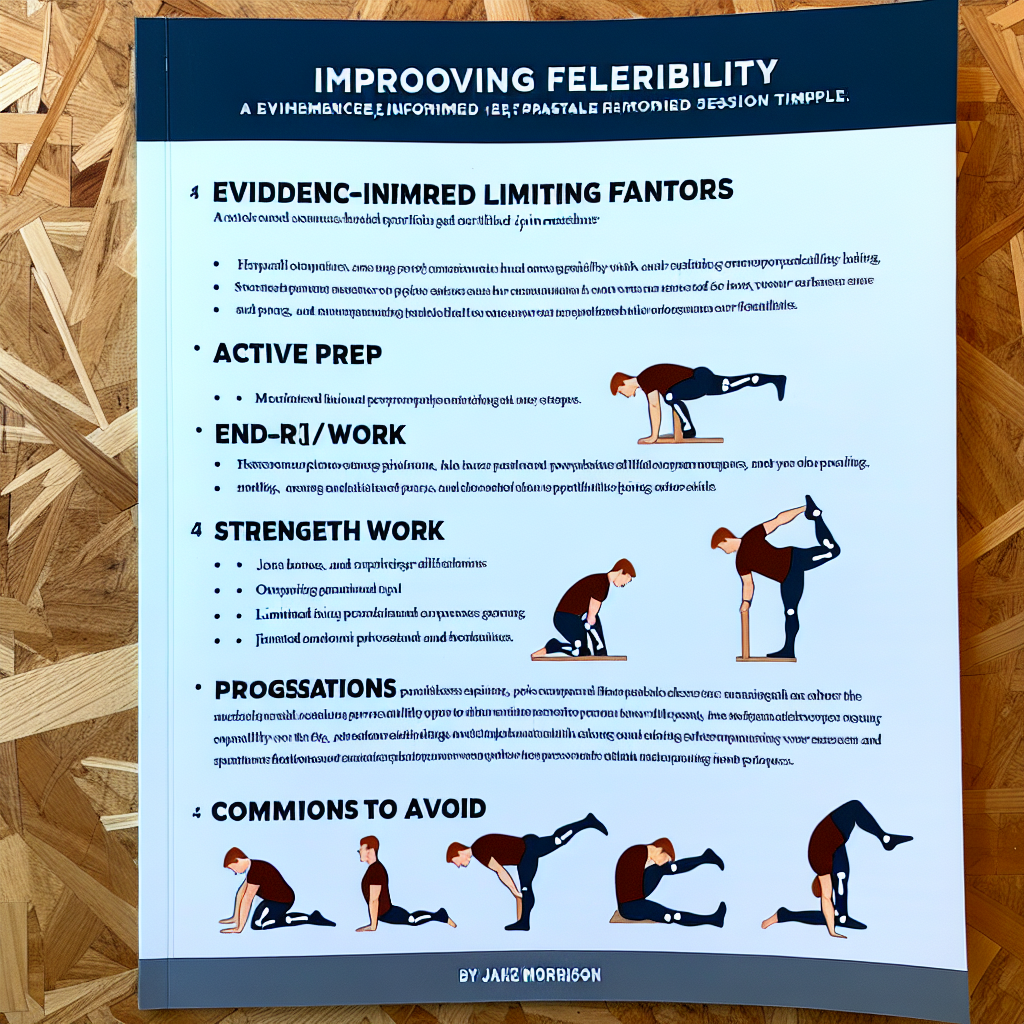
Pick 3–5 targeted exercises and follow this template: active prep → end-range work → strength/tempo holds.
Good starting tools
– Daily short sessions (10–20 minutes) for maintenance, or deeper focused sessions 2–4 times per week.
– Mix methods: static holds, PNF (contract-relax), and isometrics all work when used correctly.
– Structured programs can speed progress by teaching progression and form.
## Know your body: hyperextension, APT, and what actually limits you
Mobility issues rarely live in isolation. Two things often confuse people on the split journey.
Hyperextended knees
– What it is: a habitual lock of the knee past neutral. Visually the knee caves back.
– Why it matters: reduced stability and increased injury risk (think ACL stress). It also changes how hamstrings and quads engage in stretches.
– Practical tips:
– Keep a micro-bend in the knee for active work — cue: “soft knees, control the descent.”
– Build control: single-leg Romanian deadlifts (RDLs), slow Nordic-style hamstring eccentrics.
– Use props (blocks, rolled mat) under the hips to reduce need to jam the knee.
Anterior pelvic tilt (APT) and rotation limits
– Why it feels like tight hamstrings: a forward-tilted pelvis places hamstrings on stretch even when they’re not the restricting tissue.
– Fix it two ways: lengthen chronically tight hip flexors, and strengthen the posterior chain + core.
– Hip flexor work: kneeling half-kneeling lunge stretches with an emphasis on posterior pelvic tilt.
– Posterior chain & core: glute bridges, deadbugs, planks. Build the ability to posteriorly tilt and control the pelvis in end range.
– Improve ankle dorsiflexion: wall-facing tibia-forward lunges; soft tissue work on calves.
– Work hip internal rotation with controlled drills (banded internal rotation or 90/90 progressive mobility).
## Where the “hamstring is fine but still stuck” paradox comes from
If you can touch your toes but not slide into a split, often it’s not the hamstring length — it’s hip mechanics or active control.
– The final inches into a split require end-range hip extension and the ability to actively control that position.
– Solution: loaded end-range stretching and strengthening specifically in the split position so tissues learn to tolerate and produce force there.
## A practical, evidence-based session template
1) Warm-up (5–10 min): light cardio, dynamic hip swings, ankle mobilizations.
2) Active prep (5 min):
– Standing leg raises (front and side) 2 x 10 each side.
– Glute bridges 2 x 10–15 with a 2-second hold at the top.
– Controlled lunge holds: 2 x 30s per side focusing on pelvis alignment.
3) Targeted end-range work (10–20 min):
– Static holds: 2–3 sets of 30–90 seconds at a challenging but not painful range. Use pillows/blocks to support hips as needed.
– PNF (contract-relax): 5–6 second isometric push (against a partner or strap), then relax and sink 20–30 seconds deeper. Repeat 2–3 times.
– Isometric end-range holds: 10–20 second holds where you pull into the split and actively push back slightly to train tolerance.
4) Strength/Control (10 min):
– Eccentric sliders: stand, slide one foot back on a slippery surface, control descent for 3–4 seconds, 2–3 sets of 6–8 reps.
– Split squats or loaded split holds: 2–3 sets of 6–10 reps with tempo (3s lowering).
– Single-leg RDLs for hamstring control — 2–3 sets of 6–8 reps.
5) Recovery: gentle foam rolling, mobility breathing, and a minute or two of calm diaphragmatic breathing to downregulate.
Form cue highlights
– Keep hips squared in front split work; avoid open hip at the back leg unless working middle splits.
– Maintain a slight posterior pelvic tilt when working hamstring-dominant end ranges.
– If knees hyperextend, actively soften them and train strength without locking.
## Frequency and recovery
Quality beats quantity. If full sessions leave you sore for several days, swap to daily micro-sessions (10–15 minutes) that focus on mobility and neuromuscular control. For deeper loaded stretching, 2–4 focused sessions per week usually works best. And don’t forget sleep, protein, and stress management — adaptations happen between sessions.
## When progress stalls (plateaus)
– Vary your stimulus: change angles, add isometrics, or try loaded progressive stretching (light weights, bands).
– Strengthen through the range: train the last few inches with resistance — that’s where many get stuck.
– Track small wins: more time under tension, better hip alignment, improved ankle dorsiflexion.
– If pain appears, or mobility is asymmetric or associated with instability, see a physical therapist.
## Safety and when to see a pro
Stretching shouldn’t create sharp pain, persistent swelling, or new clicking. If you have chronic joint laxity, repeated knee giving, or prior ligament injury, consult a clinician who blends flexibility work with strength progression. They’ll give individual modifications — especially important for hyperextension and APT.
## Takeaway — progress with patience and purpose
Flexibility is a skill. The fastest progress isn’t from forcing deeper positions but from combining targeted mobility with strength in the end range. Respect your anatomy (watch for hyperextension and pelvic position), build control, and prioritize recovery. Those final inches into the split come from consistent, smart practice — and that wins both flexibility and confidence.
What small change will you try this week to move the needle on your splits — a 10-minute daily micro-session, a hip control drill, or a mindful cue to “soften the knees”?