

Hustle Smarter, Not Harder: A Practical HIIT Playbook for Busy Millennials
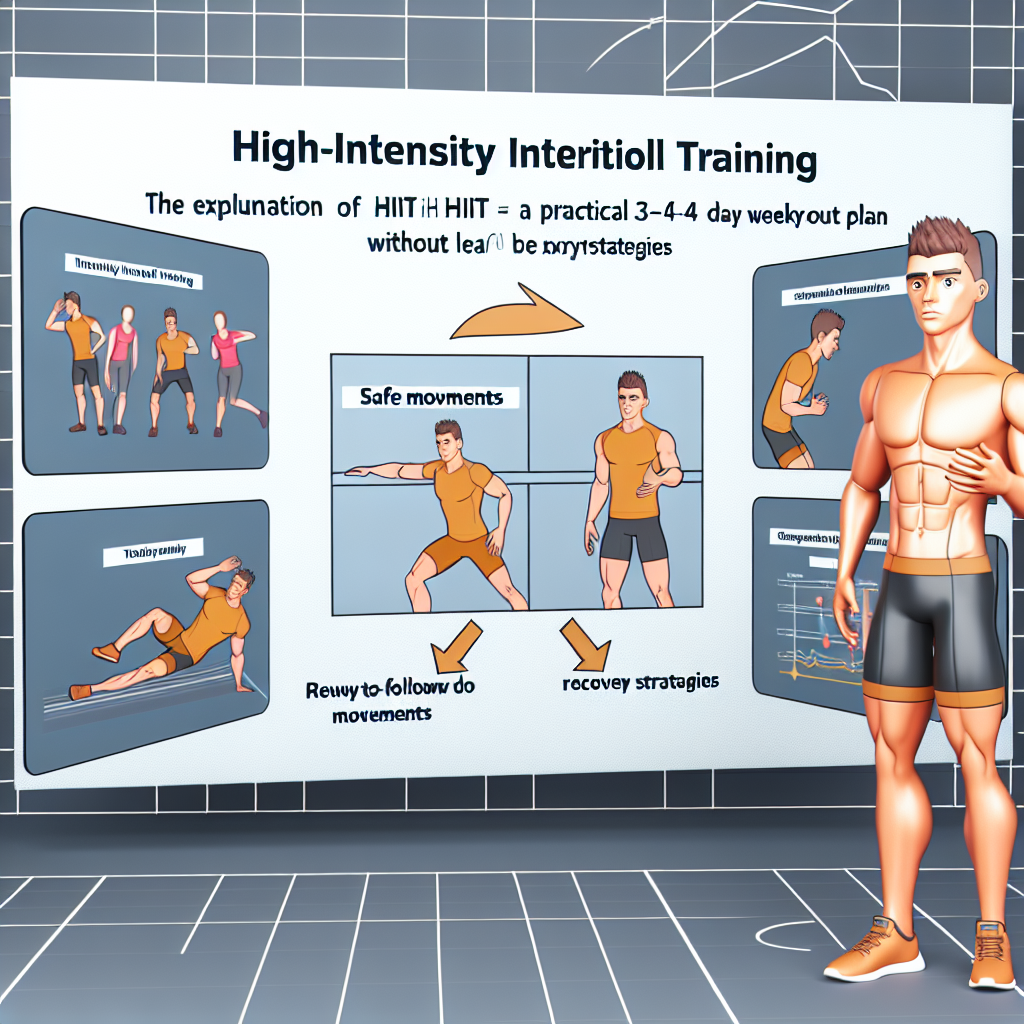
# Hustle Smarter, Not Harder: A Practical HIIT Playbook for Busy Millennials
You want results, but life is full — work meetings, side hustles, social plans. High‑Intensity Interval Training (HIIT) can deliver major fitness gains in a fraction of the time of long cardio sessions, but only if you structure it to fit your schedule, protect your form, and recover intelligently. Below is a practical, science‑minded guide to getting the most from HIIT without burning out or risking injury.
## Why HIIT works — the science, made simple
HIIT alternates short bouts of near‑maximal effort with recovery. That pattern exposes your heart, muscles, and metabolism to repeated stress and recovery, which drives adaptations like:
– Improved cardiovascular efficiency (your heart pumps more effectively).
– Better mitochondrial function (cells use oxygen and fuel more efficiently).
– Enhanced insulin sensitivity (helps with blood sugar control and body composition).
You don’t need hours on the treadmill to trigger these changes. Numerous studies show well‑designed HIIT can equal or beat steady‑state cardio for many health markers — and it takes far less time. The catch: quality matters. Poorly programmed or poorly executed intervals increase injury and burnout risk.
## Design a realistic weekly plan (consistency > heroics)
For busy professionals, 3–4 HIIT sessions per week is the sweet spot. Aim to limit gym time to 45–60 minutes on training days and place deliberate recovery between hard efforts.
Sample weekly split you can adapt:
– Monday: Rest or active recovery (30–45 min walk, mobility)
– Tuesday: Upper body power + short HIIT finisher (40–55 min)
– Wednesday: Upper accessory + core or light conditioning (45–60 min)
– Thursday: Rest or mobility work
– Friday: Longer conditioning HIIT (45–60 min)
– Saturday: Lower body strength + short intervals (30–45 min)
– Sunday: Full rest
Move days around travel and meetings — the goal is to separate hard efforts so you show up strong and avoid chronic fatigue.
## Pick the right mode for your goals and safety
Not all HIIT is created equal. Choose your modality based on goal, space, and technique:
– Treadmill, bike, rower: Safe for high heart rate with low skill requirements. Good default for busy people.
– Stairclimber, box jumps, plyometrics: Great for power but higher fall/impact risk — use when rested and focused.
– Bodyweight or resistance HIIT: Works for strength and conditioning, but avoid heavy, complex lifts near maximal fatigue. Use lighter loads, higher reps, or simpler patterns when pushing limits.
Practical rule: when coordination starts to fail, pick a safer, simpler movement.
## When motor control goes: why you feel clumsy and what to do
Losing coordination at peak effort is normal. It’s not just lactic acid — it’s metabolic and neuromuscular fatigue that temporarily reduces fine motor control.
Fixes you can use immediately:
– Choose safer movements (bike sprints instead of loaded snatches).
– Shorten work intervals or lengthen recovery — swap a 5‑minute push for multiple 30–60 sec all‑outs.
– Practice under fatigue using controlled drills (bodyweight squats, planks) so your nervous system adapts.
– Stop being a hero: if technique collapses, pause, reduce intensity, or switch to a low‑risk movement.
## Templates you can use today
Start simple and scale intensity as fitness improves. Warm up for 8–12 minutes before each session (dynamic movement, joint rehearsal, short bursts to raise HR).
– Long intervals (for experienced users): 10 min warm‑up → 5 min @ 85–95% HR → 2–3 min easy → repeat 3–5 rounds → cool down.
– Classic intervals (beginner to intermediate): 10 min warm‑up → 1 min hard (~90% effort) → 1–2 min easy → repeat 8–12 times → cool down.
– Tabata style (advanced, keep movements simple): 20 sec max → 10 sec rest → 8 rounds (4 min total). Use for metabolic finishers, not as a main heavy lifting template.
Example session (Classic intervals, bike): 10 min warm‑up → 1 min seated sprint → 90 sec easy spin × 10 → 5 min cool down.
## Exercise & technique breakdown — practical coaching cues
– Sprint on a bike: Maintain tall chest, relaxed shoulders, brace your core, and drive through the pedal stroke (think forceful hip extension). Short intervals (20–60 sec) keep form clean.
– Kettlebell swings (conditioning): Hinge at the hips, neutral spine, drive with glutes — don’t pull with the arms. Reduce reps when your hip hinge degrades.
– Box jumps: Soft landings, hips back on approach, don’t overreach height early in a session.
Common mistakes and quick fixes:
– Mistake: Grinding through intervals with rounded back or flared ribs.
Fix: Slow down, reset posture between reps, or shorten the interval.
– Mistake: Using heavy loads for high‑rep HIIT when fatigued.
Fix: Drop load, increase reps, or replace with bodyweight variations.
– Mistake: Skipping the warm‑up.
Fix: Commit to 8–12 minutes of progressive warm‑up — it saves you downtime for injuries later.
## Warm‑up and recovery — non‑negotiables
Warm up to prime muscles and reduce injury risk: 8–12 minutes of mobility, dynamic rehearsal, and ramped intensity. After HIIT, prioritize:
– Mobility and foam rolling for 5–15 minutes.
– Protein within 1–2 hours for muscle repair.
– Prioritize sleep and at least one passive rest day per week.
For busy adults, small habits (consistent sleep window, protein at breakfast) compound into better recovery and harder, higher‑quality training sessions.
## How to make HIIT feel doable — motivation and community
HIIT’s variety is its magic. Mix modalities to stay interested. Celebrate small wins — more consistent weeks, better form, longer intervals completed. Find accountability: a workout buddy, a group class, or an online community that matches your vibe.
Remember: progress is a series of small, consistent wins. You don’t need to be impressive every session — you need to be consistent.
## Safety checklist (read before you hit max effort)
– Keep sets short when technique matters.
– Scale loads down if form breaks.
– Track perceived exertion or heart rate to avoid chronic overreach.
– New chest pain, dizziness, or unusual symptoms? See a clinician before doing maximal work.
## Takeaway — practical, not preachy
HIIT can be an efficient, effective tool for busy millennials who want real fitness results without giving up life. Build a 3–4 day weekly plan with clear rest days, choose movement types that match your skill and fatigue level, and prioritize warm‑ups and recovery. When motor control wanes, dial back intensity or simplify movements — progress matters more than showing off. Stick with a sustainable routine, connect with a supportive community, and you’ll get fitter, faster, and more resilient — without sacrificing your schedule.
What’s one HIIT tweak you’ll try this week to make your workouts safer, shorter, or more consistent?